10/25/2006


Oct 25th Winner

DOUG SHORT

Rule Clarifications

There are a couple of rules that i would like
to clarify. I hope you will all help me spread
this knowledge at the tables as situations arise.

#1
Show One, Show All vs. Show One, Show Both

The primary reason behind " show one show all " is that players are entitled to receive equal access to information about the contents of another player’s hand. After a deal, if cards are shown to another player, every player at the table has a right to see those cards. During a deal, cards that were shown to an active player who might have a further wagering decision on that betting round must immediately be shown to all the other players. If the player who saw the cards is not involved in the deal, or cannot use the information in wagering, the information should be withheld until the betting is over, so it does not affect the normal outcome of the deal. Cards shown to a person who has no more wagering decisions on that betting round, but might use the information on a later betting round, should be shown to the other players at the conclusion of that betting round.

" Show one, show both " is often confused with show one, show all. If only a portion of the hand has been shown, there is no requirement to show any of the unseen cards. The shown cards are treated as given in the preceding part of this rule. Some times a player will show one of his hole cards after all other players have folded and he has won the pot. This Is Allowed and he is not required to show both of his hole cards because he exposed one of them.

Where "show one, show both" comes into play is at the showdown. The rules state " To win any part of a pot, a player must show all of his cards faceup on the table, whether they were used in the final hand played or not". For example: A player used the Ace of Spades from his two hole cards to make an Ace high straight. That player must still turn over BOTH of his cards in order to win the pot, even though he is only using one of his hole cards and four board cards.

#2 Single Chip Bet

A bet of a single chip without comment is considered to be the full amount of the chip. However, if a player is acting on a previous bet with a larger denomination chip, he is calling the previous bet unless this player makes a verbal declaration to raise the pot. As an example: The Blinds are $100/$200, when a player bets $400 and the next player puts a $1000 chip in the pot without saying anything, that player has merely called the $400 bet. This same rule applies to acting on the forced bet of the big blind. The blinds are $100/$200 and the first player to act throws in a $500 chip without saying anything. He has only called the $200 big blind. This is why one of the things I always say in my little rules speach before the final table is "please announce all your raises".

10/24/2006

1st London WILDCARD Event

This Sunday... OCTOBER 29th

at Mexicali Rosa's 288 Dundas St.

at 2pm will be the 1st of 3 WildCard events.

The winner of sundays tournament will

automatically advance to the championship

tournament on Dec 3rd regardless of their

point standings. This is an especially great

opportunity for those who cannot attend regularly

or those who've been on a tough run of luck

to show off their poker skills and earn a spot in

the Championship.

Season 6

Season 5 will end on November 25th, 2006.

Season 6 will start November 26th, 2006.

CHAMPIONSHIP Date Announced

Season 5 Championship

SUNDAY DECEMBER 3rd

Bobby D's Billiards and Grill
2317 Fairview St. Burlington
905-639-5550


Starts at NOON.
Registration starts at 11am
Dont be late. Spots for "No-Shows"
will start being given away if you're
not registered by 11:45.

10/23/2006

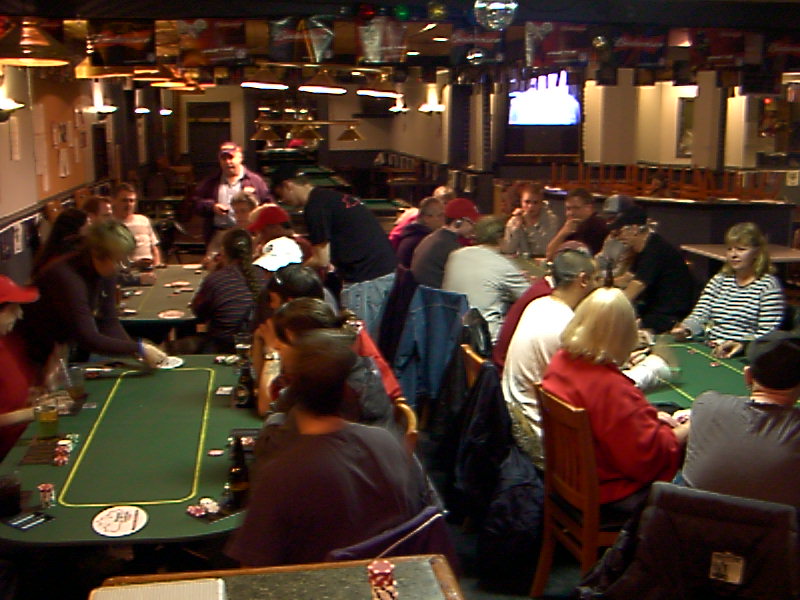
Poker In Canada Tour - Bradley Roadhouse

click photo to enlare

10/22/2006

Online Bounty Announced

There is a special Bounty for the
Online event Oct 27, 2006 at PokerInCanada.com

Any London member of the Poker In Canada Tour
who eliminates either PICTourMgr (Chris) or
sun_man (Sonny) will have their entry into the
following Fridays tournament paid for by me (Will).

For those unfamiliar with our Friday night online
tournaments:

go to http://www.pokerincanada.com
Sign up using Bonus Code: PICTOUR
You Must Email your Name, Membership #, & UserName
to Chris@PokerInCanadaTour.com to be awarded Points.
Go to: "Registering Tournaments" and find "PIC Tour"
Tournament Starts at 8PM
$5.00 Buy-In (One $5.00 Rebuy allowed
Optional $5.00 Add-On at 1st break)
All money goes into the prize pool.
Poker In Canada Tour Members are awarded
points for Top 8 in addition to any cash prizes.

Playing SMALL POCKET PAIRS (video)

A short video by Phil Gordon on
how to play small pocket pairs.


http://www.youtube.com/watch?v=UAQPE3fPGXY

The Value Of Suited Cards (Video)

A short video from Phil Gordon which
explains the real value of your cards being suited.

http://www.youtube.com/watch?v=EUeghUzZ-So

Why you DONT SLOWPLAY ACES !


Click Photo to Enlarge It

Poker In Canada Tour - Mexicali Rosa's

click photo to enlarge
Oct 22nd
Back-to-Back Winner

JANICE MEYER

Oct 22nd
Winner


JANICE
MEYER

10/21/2006

POKER SKILLS: STEALING BLINDS

Multi Table Tournament Blind Stealing
by Scott Paterson

First, let me clarify what I mean by blind stealing.
I’m talking about a pure steal. Raising someone’s
blind with a marginal hand, or any two cards hoping
they’ll fold and confrontation can be avoided.

Certain criteria must be met in order to successfully pull this off:

1. You should only be doing this in the middle/late stages
of the tournament when the blinds are higher. Blind stealing
is pointless early on because the starting pot is so small.
The negative consequences of "getting caught" and losing
a chunk of your stack early on far outweigh the positive effects
of winning a small pot early on. In the middle stages of the
tournament you’ll want a decent hand to back you up.
In the late stages of the tournament, or if you’re short stacked
you may need to make this move with any two cards.
Also, a great time to steal blinds is right before the final table
as players tighten up hoping to survive and avoid being eliminated
or losing a bunch of chips.

2. You should only be stealing from players you’ve identified
as tighter players. Prime candidates are people that play
one or two hands per table revolution, and players that
don’t defend their blinds against raises. Pay close attention
to the three people seated on your left (these are your potential
victims because you’ll be in late position when these people
are in the blinds). Who is folding a lot of hands?
Who isn’t defending their blinds against raises?
You’ll want to lean on these people hard.

3. You should usually only try this from late position
when everyone has folded to you, or a limited number
of people have limped in front of you.
First, if you raise the blinds from late position and
one of the blinds call your raise you may have the
opportunity to steal the pot after the flop because
you have position on them.
Second, if you try this from early/middle position
someone behind you could easily pick up a hand
and reraise, a short stack could move all in, or a big stack
with a speculative hand could call your raise with the
intention of stealing the pot from you after the flop.
Finally, the ideal time to try this move is when everyone
has folded to you, or there have been a limited number of
callers in front of you. As the number of callers in front of
you increases the chance you will get backraised increases
(someone in front of you might have limped in with a very
strong hand counting on you to raise behind them).
The "usually" stems from the fact that if you are shortstacked,
or it’s late in the tournament (the blinds are very high and
they come around very quickly) you might want to try this
from any position.

POKER SKILLS: TELLS

by Scott Paterson

A tell is anything that your opponent(s) do
to give away the strength of their hand.

Tells can be verbal or physical, and they can be instinctive
(unintentional) or designed to mislead (intentional).
Instinctive tells are more reliable, whereas tells designed to
mislead are much harder to decipher.

When you spot what you think is a tell the first thing you should
ask yourself is whether or not the tell you’ve spotted is instinctive
or put on (hint: instinctive tells are more common among average
players, tells designed to mislead are more common among strong
players). Then watch your opponent(s) closely over the course of
a few hands, and see if you can spot a pattern.

Some of the more common tells include:

Betting patterns (instinctive)
Betting patterns are easily the most common and most

reliable tell. They’re common because everyone must bet
at some point during the game. They’re reliable because it’s
human nature to make the best play we think possible.
Oftentimes that means creating patterns.
Does your opponent check or bet their draws?
Does your opponent slow play or bet their strong hands?
What does a minimum bet/raise from your opponent mean?
Does your opponent overbet the pot in an effort to protect weak hands?
All of these things create a pattern which you can use to help
determine the strength of your opponents hand.

General body language (instinctive)
This tell is fairly common and fairly reliable. Your opponent’s

posture will often give away the strength of their hand. Was your
opponent sitting back before looking at their hole cards or the flop,
and is now sitting up looking interested? Something what I like to do
is watch an opponent who has bet out and is awaiting a call.
Watch them closely as the person behind them acts. They’ll often
let you know how they feel about a potential call or raise
(particularly if the person behind them begins to count out chips).
Hand motions can also give away the strength of your opponent’s
hand. Watch how they put their chips in the pot. Players wanting
a call will often place their chips in the pot inconspicuously
(they don’t want to intimidate potential callers).

Chip loading (instinctive)
This tell is common and fairly reliable. Players that are dealt strong

starting hands, or that connect on flops often immediately glance at
their chips. I’m not talking about players that look at their chips
when the action is on them. I’m talking about an immediate and
very brief glance at their chips after they look at their hole cards,
or the flop comes out. Sometimes players don’t even move their heads,
Just their eyes. Preflop, I like to watch my opponent(s) look at their
hole cards, and then look at mine as the action approaches me.
I also like to watch my opponent(s) as the flop comes out, and then
look at the flop as the action approaches me.

Staring (attempt to mislead)
This tell is fairly common, but a little less reliable because

it is an attempt to mislead. There are actually three
manifestations of this tell, but they all mean basically
the same thing. Players that stare at their hole cards,
stare at flops, or stare down opponents are usually weak.
All are thinly veiled attempts to intimidate. Players stare
at their hole cards to make their opponents think that they
possess a powerful hand. They’ll stare at flops for the
same reason. After they bet, they’ll often stare down potential
callers to intimidate them. Since this tell is less reliable
you’ll really have to watch for a pattern to develop.

Gaining information
There are two things I like to do in order to elicit tells from

my opponent(s):

Reach for chips as an opponent is betting
If my opponent hesitates, looks back at his cards, or completes

his bet with added emphasis he/she is likely weak. If he/she
completes their bet in a smooth manner their likely strong.

Count out chips & make it look like I’m going to call
If my opponent stares at me or looks back at their cards

he/she is likely weak. If my opponent smiles at me genuinely
or appears uninterested he/she is likely strong.

REMEMBER: Tells become more reliable as patterns develop.


Oct 21st Winner

ADAM QUEHL

To Bluff or Not to Bluff

by Scott Paterson


The following are some factors to consider
when deciding whether to bluff or not:

Number of opponents
This one is a no brainer. A bluff is far more likely to succeed
against a single opponent. Your goal is to make your opponent(s)
fold. As the number of opponents increases the chances of
getting a caller increases.


Type of opponent(s)
Consider the type of player(s) you are trying to bluff.
Tight players usually will not call your bluff unless they
have a reasonable hand (your bluff forces tight players
to have a hand in order to call). Strong players can
lay down a hand if they think they’re beat (strong players
are able to at least consider the possibility that your hand
may be superior to theirs). Try to avoid bluffing loose or weak
players because you’ll get called more often than not.


Your table image
If other people at the table see you playing an inordinate number
of hands, showing down weak hands, betting at every flop,
or raising/reraising frequently they’re more apt to call your bluff.
They know that if you’re playing too many hands you must be
playing some weak hands, and if you’re betting too often you
cannot possibly have something every time you bet.
Tighter players have more license to bluff because they play
relatively few hands, and are therefore often given credit for
stronger hands.

Your "Reading" skills
The better your reading skills are the more opportunities
you will have to bluff. If a tighter player flat calls before you,
and the flop is 4c 8h 2d you can attempt a steal. They probably
have unpaired overcards. They can’t have an overpair to
the board because they likely would have raised preflop.
They haven’t made a set from paired hole cards because
they checked their hole cards after the flop (a player who flops
a set from paired hole cards doesn’t usually need to check
and see if they’ve done so). They don’t have two pair because
they aren’t likely playing 48, 42, or 82. There is no flush draw.
This player is fairly tight. He may have A8 suited or A4 suited
and has top/middle pair. He may also have A5 suited and has
an inside straight draw. Unpaired overcards are most likely,
and you should take a stab at this pot. If he raises you some
additional thought may be necessary. Reads will rarely be
this simple, but learning to read hands will pay off in the long run.

The size of the pot
It’s much easier to steal small and medium sized pots
than it is large pots. Players are usually more heavily invested
in large pots, and large pots are simply more attractive and
psychologically harder to let go of.


10/20/2006

Please Dont Be....Like Tony G.

Videos of the always obnoxious Tony G. during
his most famous tongue lashing at the WPT.

http://www.youtube.com/watch?v=bMPdKJXR6qo

http://www.youtube.com/watch?v=p-4GDyHhEC4

http://www.youtube.com/watch?v=tqnHX9tQv-w

Is this your picture ?

Probably not, but I bet you know
who's X-Ray this is....


10/19/2006


Oct 19th Winner

CHEVY GIES