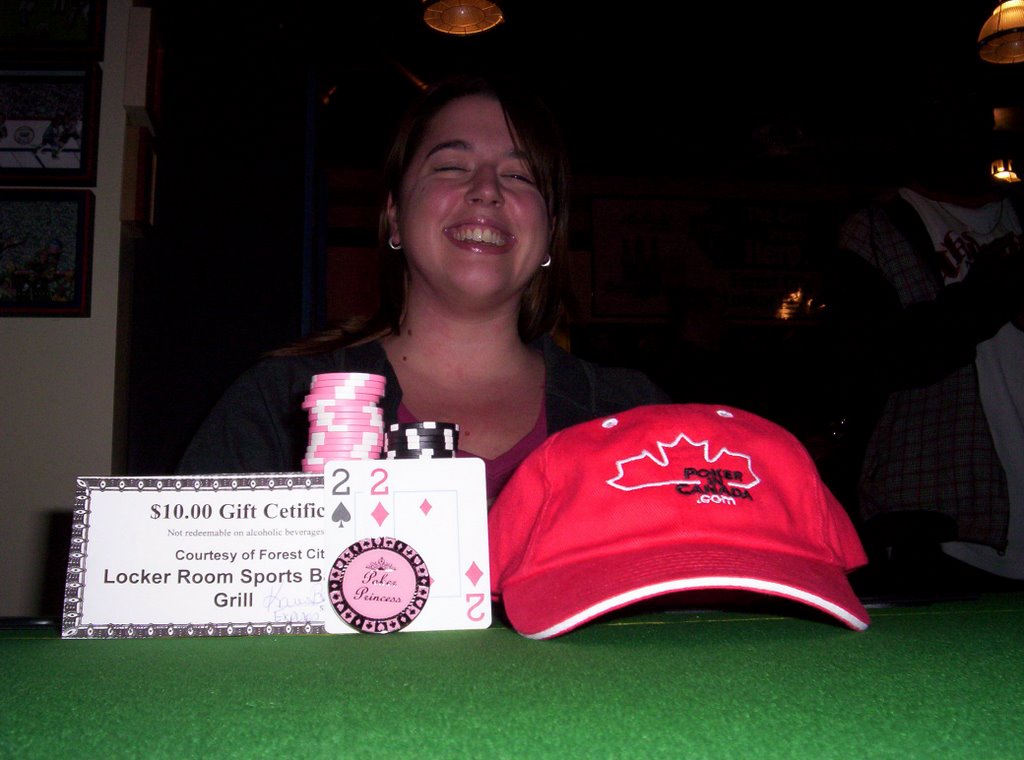
Sept 30th Winner
JANICE MEYER

Sept 28th Winner
GINA REED

Sept 27th Winner
MIKE
MCINTYRE

Sept 25th Winner
ROB PINCOMBE

Sept 24th Winner
SEBASTIEN DEROY

Sept 21st Winner
JANICE MEYER

Sept 20th Winner
PENNY
STODDART

Oct 18th Winner
NICK DAVIES
 Sept 17th WinnerMATT MALLON
 Sept 17th WinnerLUIS COY
by Scott PatersonHow should you proceed when you know you don’t have the best hand, but you have a decent chance to make the best hand and take down the pot? You should connect the pot odds to your hand odds to see if your pursuit of the best hand will be profitable in the long run.
How do you do this?
Count the number of outs that you feel will give you the best hand. Convert your outs to odds against.
Compare the pot odds to your hand odds (the general rule is that your pot odds should be greater than the odds against you making the winning hand).
Example
You possess the K 10 of spades. The flop comes A of spades, 4 of hearts and 8 of spades. You’ve flopped a four flush and have a draw to the nut flush. From the preflop action you’ve deduced that your opponent possesses a big A, or a medium pocket pair. He probably has top pair with a good kicker, but he may also have a set (888). In either case you are likely going to need the nut flush to beat him (if he has top pair with a big kicker you’ll need runners to beat him and even then you might not because one of your runners could easily give hima bigger two pair). How likely is it that you’ll get your flush on the turn? You have two cards in your hand, and there are three on the board. That means that there are 47 unseen cards left. You have two spades in your hand, and there are two on the board. That means there are 9 spades left. Among the 47 unseen cards 36 will not help you and 9 will. The odds against you completing your flush on the turn are 36:9 or 4:1. Now we need to compare the odds against you making your hand to what the pot is paying you to make the call. The pot was at 400 chips just prior to the flop, and after the flop your opponent bet 100 chips. The pot now stands at 500 chips, and it will cost you 100 chips to call. The pot is paying you 5:1 on your call. Now we can compare the pot odds to your hand odds. Your pot odds (5:1) are greater than the odds against you making your flush (4:1). This means that it will be profitable in the long run to call your opponents bet.
Why is it profitable?
Your hand odds are 4:1, and the pot odds are 5:1. If you pursue the flush 5 times, you will miss it 4 times and hit it 1. The 4 times you miss will cost you a total of 400 chips. The 1 time you hit will win you 500 chips, plus you’ll get your 100 chip call back.
Note:
Outs are routinely calculated using unseen cards because you’ll have no idea what other people have folded.